Choosing the right Aluminum Entrance Door manufacturer or supplier involves more than comparing glossy photographs and low quotations. Performance begins with the details: alloy grade, frame thickness, thermal-break design, drainage paths, glazing quality, and hardware durability. A reliable supplier should explain these specifications clearly and provide verifiable test reports, warranty terms, installation guidance, and project references. Doors should feel solid when operated, close evenly, and withstand repeated use without excessive movement or noise.
This guide examines leading manufacturers and suppliers through practical criteria used by architects, contractors, distributors, and property owners. It considers product customization, weather resistance, energy performance, surface finishing, production capacity, delivery consistency, and after-sales support. Factory experience matters. So does communication.
A polished catalog can still hide important limitations. Some suppliers offer impressive finishes but provide weak technical documentation. Others promise short lead times without explaining packaging, inspection, or shipping risks. Those gaps deserve attention. No single manufacturer fits every project, because coastal homes, commercial entrances, apartment buildings, and luxury developments require different solutions. This comparison aims to present useful, balanced information rather than force a convenient winner. Readers should confirm local building requirements, installation conditions, and warranty coverage before placing an order. Small details often decide long-term value. A beautiful door is not automatically a dependable one.
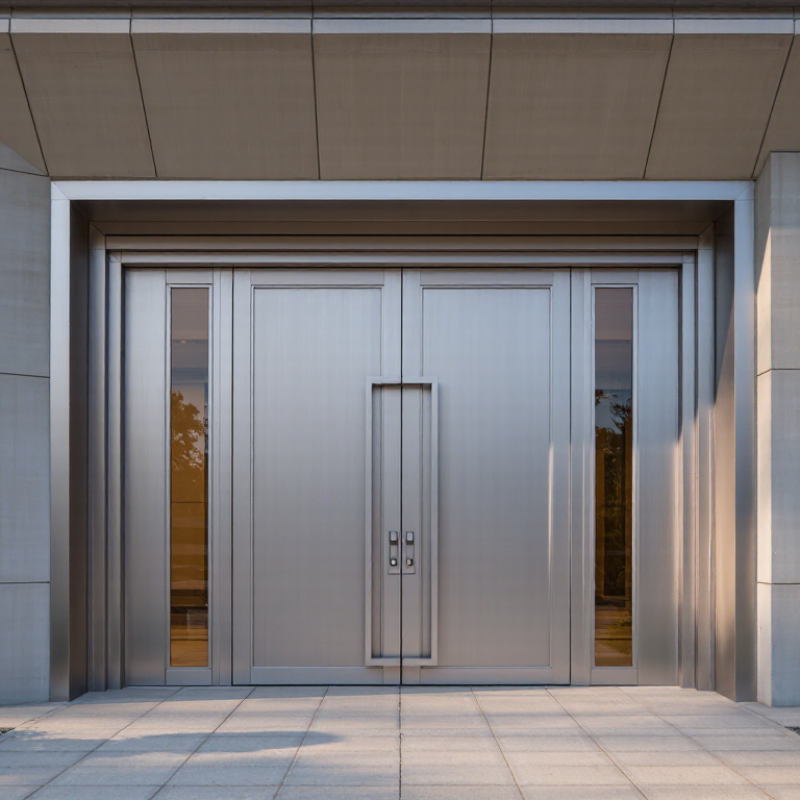
Aluminum entrance doors are exterior door systems built with aluminum frames, panels, glass, seals, hinges, and locking hardware. Aluminum is light but structurally strong, making large door openings easier to operate. It also resists rust better than untreated steel in many climates. That matters near coastal air, where moisture quickly damages weak finishes. A thermal-break frame can reduce heat transfer between indoors and outdoors. Without it, the metal may feel cold and create condensation during winter.
Their popularity comes from clean appearance, flexible sizing, and relatively simple maintenance. Powder-coated surfaces can provide stable color and protect the frame from weather exposure. Narrow profiles also allow more daylight through a glass entrance. However, performance depends on the complete system, not aluminum alone. Poor seals, weak drainage, or badly adjusted hinges can cause drafts and water entry. This is where experienced manufacturers and suppliers should provide tested specifications, installation guidance, and compatible hardware.
Buyers should check air leakage, water resistance, wind-load performance, glass safety, and thermal values before ordering. Local climate and building requirements deserve attention. A door facing strong afternoon sun may need suitable glazing and shading. Large doors can look impressive, but they require accurate structural support and careful alignment. They are not maintenance-free. Inspecting seals, cleaning tracks, and checking fasteners periodically can prevent small problems from becoming expensive repairs. Even a well-designed entrance can perform poorly when installation is rushed.
Choosing an aluminum entrance door manufacturer requires more than comparing catalog photos and quoted prices. Look for proven experience with projects similar to yours, including residential buildings, offices, or coastal properties. Ask how long the production team has worked with aluminum systems. Request photographs of completed installations, not only computer renderings. Real details matter.
A reliable supplier should explain alloy grades, profile thickness, thermal breaks, drainage paths, and surface treatments in clear language. Check whether doors are tested for air leakage, water resistance, wind pressure, and repeated opening cycles. Independent test reports carry more weight than attractive claims. Also examine hardware quality, gasket replacement procedures, and adjustment access after installation. Small components often decide long-term performance.
Communication is another practical test. A professional manufacturer should provide accurate drawings, measurable tolerances, finish samples, and a written production schedule. Confirm who checks dimensions before fabrication. One overlooked opening can cause expensive delays. I have seen impressive doors fail because the threshold was poorly detailed. That experience changed how I evaluate suppliers. Do not ignore after-sales support, either. Ask how damaged panels, faded finishes, or alignment problems are handled. A dependable partner answers specific questions, admits limitations, and documents corrective actions. Some suppliers may not offer the lowest price. That is not automatically a weakness. Thin profiles, weak testing, and vague warranties can cost more later.
| Evaluation Category | Key Metric | Practical Screening Reference | Why It Matters | Recommended Evidence |
|---|---|---|---|---|
| Product Compliance | Applicable testing and certification | Products should be tested against the standards required in the target market, such as EN 14351-1, EN 12207, EN 12208, or local building codes. | Confirms that the door has been assessed for safety, weather resistance, and performance. | Current test reports, declarations of performance, certificates, and laboratory details. |
| Thermal Performance | Door U-value or U-factor | Compare complete-door values rather than frame-only values. Lower U-values indicate better resistance to heat transfer; the required level depends on climate and code. | Helps reduce heat loss, condensation risk, and energy consumption. | Whole-door thermal calculations or test results showing frame, panel, glass, and hardware assumptions. |
| Thermal Break Design | Frame and panel thermal isolation | For conditioned buildings, verify the use of polyamide or another engineered thermal-break system where required by the design. | Reduces direct heat transfer through the aluminum frame and improves interior surface temperatures. | Cross-section drawings, thermal-break dimensions, material specifications, and condensation analysis. |
| Air Tightness | Air leakage classification | A documented air-leakage class under the applicable regional standard is preferable; tighter performance is generally beneficial for conditioned interiors. | Limits drafts, dust infiltration, and uncontrolled energy loss. | Air-permeability test report for the complete door assembly, including seals and hardware. |
| Water Resistance | Water-tightness rating | Select a rating appropriate for the building height, exposure, wind-driven rain, and local climate; higher exposure requires stronger protection. | Reduces the risk of water penetration, interior damage, and premature deterioration. | Water-tightness test results, sill details, drainage design, and installation instructions. |
| Wind and Structural Strength | Wind-load resistance and deflection | The required resistance depends on door size, location, building height, and design wind pressure. Large entrance doors need project-specific calculations. | Prevents distortion, difficult operation, and seal failure under wind pressure. | Structural calculations, test reports, maximum panel dimensions, and approved fixing details. |
| Material Quality | Aluminum alloy, temper, and wall thickness | The alloy and profile thickness should be clearly specified and selected according to structural, dimensional, and corrosion requirements. | Consistent material quality supports strength, dimensional stability, and long service life. | Mill certificates, profile drawings, thickness tolerances, and incoming-material inspection records. |
| Surface Finish | Finish type, coating thickness, and color consistency | Common options include powder coating, anodizing, and wood-effect finishes. The specification should identify the finish system and required durability class. | Protects aluminum from weathering and supports the desired architectural appearance. | Coating certificates, color samples, gloss or appearance limits, and corrosion-resistance test data. |
| Hardware and Security | Locking system, hinges, cylinders, and access-control compatibility | Confirm that hardware is rated for the door weight and cycle frequency, with multi-point locking available where the project requires it. | Affects security, smooth operation, maintenance, and replacement cost. | Hardware schedules, cycle-test results, security classifications, and spare-parts availability. |
| Glass and Glazing | Glass type, safety rating, and glazing method | Use safety glass where required by code. Double or triple glazing may be specified when improved thermal or acoustic performance is needed. | Influences occupant safety, insulation, noise control, and visual design. | Glass certificates, thickness information, spacer details, sealant specifications, and glazing instructions. |
| Customization Capability | Available dimensions, configurations, finishes, and accessories | Evaluate the supplier’s ability to produce single, double, pivot, sliding, glazed, solid, or oversized entrance-door configurations as required. | Improves design flexibility and reduces the need for costly site modifications. | Technical catalogs, shop drawings, sample approvals, and documented dimensional tolerances. |
| Quality Control | Inspection procedures and traceability | A robust process should include incoming-material inspection, in-process checks, final dimensional inspection, and packaging inspection. | Consistent quality reduces installation problems, defects, and warranty claims. | Quality manual, inspection checklist, batch records, nonconformance procedure, and product traceability. |
| Lead Time and Capacity | Quoted production schedule and manufacturing capacity | Compare the confirmed production lead time, approval period, shipping time, and contingency plan rather than relying only on an estimated delivery date. | Supports reliable project scheduling and reduces the risk of construction delays. | Written production schedule, capacity information, order milestones, and shipment tracking process. |
| Packaging and Logistics | Protection during handling and transport | Packaging should protect corners, glass, hardware, and finished surfaces, with clear identification for multi-door projects. | Reduces transit damage, misdelivery, and installation-site confusion. | Packaging photos, loading procedures, labeling examples, insurance terms, and damage-claim process. |
| Installation Support | Site and installation documentation | Look for clear sill, anchoring, sealing, leveling, drainage, adjustment, and maintenance instructions. | Correct installation is essential for achieving the tested air, water, thermal, and security performance. | Installation manuals, CAD details, method statements, training, and technical-response procedures. |
| Warranty and After-Sales Service | Warranty scope, duration, exclusions, and response time | Review separate coverage for profiles, finish, glass, hardware, seals, and electronic components. Terms should be stated in writing. | Clarifies long-term responsibility and potential maintenance costs. | Warranty document, service contacts, spare-parts policy, claim procedure, and repair lead times. |
| Sustainability | Recycled content, recyclability, and environmental documentation | Aluminum is widely recyclable. Verify recycled-content claims, environmental product declarations, responsible sourcing, and coating-related documentation where relevant. | Supports environmental targets and transparent project reporting. | Environmental product declarations, recycled-content certificates, material declarations, and waste-management records. |
Top Aluminum Entrance Door Manufacturers and Suppliers
Leading aluminum entrance door suppliers usually fall into four practical groups: extrusion manufacturers, custom fabricators, project specialists, and regional distributors. Extrusion manufacturers produce profiles with consistent wall thickness and alloy control. Custom fabricators cut, weld, glaze, and finish doors for specific openings. Project specialists add thermal calculations, access hardware, and installation coordination. Distributors offer faster availability, but their customization may be limited.
Supplier evaluation should include more than price. The International Aluminium Institute reports that recycled aluminum requires about 95% less energy than primary production. This makes recycled-content verification a useful purchasing question. The 2024 UNEP Global Status Report for Buildings and Construction states that buildings and construction consume about 32% of global energy and create roughly 34% of global carbon emissions. Therefore, suppliers should provide thermal-break details, U-value evidence, air-infiltration results, and documented material sources.
Ask for tested samples.
A strong supplier can explain frame depth, drainage paths, coating thickness, and hardware maintenance without vague claims. Look for test reports from recognized laboratories, not only factory brochures. Experience matters when doors face coastal salt, heavy rain, or frequent public use. However, recycled content alone does not guarantee a better door; poor sealing can waste more energy during service. That point is often overlooked. Local installers may understand site conditions better, while large manufacturers may offer stronger testing systems and longer production capacity. The best choice depends on verified performance, replacement support, and clear communication from quotation to installation.
Commercial aluminum entrance doors are commonly supplied through specialist system fabricators, storefront contractors, automatic-door integrators, and architectural door manufacturers. The chart compares typical single-opening clear widths used for major aluminum entrance-door configurations.
Typical industry ranges shown for preliminary comparison only; actual dimensions depend on local building codes, hardware, structural requirements, and project specifications.
Aluminum entrance doors begin with a measured design, not a catalog image. Experienced manufacturers study opening size, climate, traffic, and security requirements. Design teams select aluminum profiles, thermal breaks, glass, seals, hinges, and locking hardware carefully. A thermal break reduces heat transfer through the frame. Drainage channels help move rainwater away from the interior. Suppliers should provide drawings, material details, finish samples, and documented test results. Mock-ups reveal weaknesses early. Not every drawing survives real use.
Tips: Check profile thickness and corner joints. Ask how water drains. Confirm the glass specification. Request independent laboratory reports, not only sales claims. Visit a working factory when possible. Small details matter.
During production, aluminum profiles are cut, drilled, and assembled with controlled tolerances. Corners may be mechanically joined or reinforced, depending on the design. Surface finishing must be inspected for color consistency, adhesion, and visible defects. Skilled quality teams record batch information and inspection results. Testing usually examines air leakage, water penetration, structural pressure, operating cycles, and hardware performance. Corrosion resistance may also be evaluated for coastal or humid locations. These tests support dependable purchasing decisions, but results can vary after installation. Poor alignment, damaged seals, or uneven walls may reduce performance. That limitation deserves honest attention.
Selecting an aluminum entrance door supplier starts with performance evidence, not showroom appearance. Ask for independently verified air, water, structural, thermal, and cycle-test results. These documents reveal more than a polished sample. UNEP’s 2023 Global Status Report says buildings consumed 34% of global energy in 2022. That figure makes thermal design a procurement issue, not a decorative upgrade.
Compare whole-door U-values, frame depth, thermal breaks, gasket design, and threshold details.
Do not accept a center-panel figure as the complete assembly result. The U.S. Department of Energy estimates windows account for 25–30% of residential heating and cooling energy use. Glazed entrance sections deserve similar attention.
Your project may perform differently. Request a tested corner sample, finish sample, and installation detail before approval.
Site exposure matters.
Evaluate suppliers through factory audits, recent project references, response times, and change-control procedures. Ask who owns the drawings, how revisions are logged, and where replacement parts are stocked. International Aluminium Institute data indicates recycled aluminum uses about 5% of primary aluminum’s energy. Verify recycled-content claims with chain-of-custody records. Cost is still important, but the lowest quotation can hide weak packaging, slow remakes, or difficult installation. That risk deserves a line item.
Look for completed projects resembling yours, such as homes, offices, or coastal buildings. Request installation photographs, not only computer renderings. Real details matter. Ask how long the production team has worked with aluminum systems.
Request the alloy grade, profile thickness, thermal-break design, drainage paths, and surface treatment. Ask for clear explanations. Vague answers deserve caution. Small details often control long-term performance.
Ask for independent reports covering air leakage, water resistance, wind pressure, thermal performance, and opening cycles. Tested assemblies matter more than attractive claims. A polished sample proves little.
Compare whole-door U-values, not only center-panel figures. Check frame depth, thermal breaks, gaskets, glazing, and threshold details. Energy losses can hide at the edges. Your building may perform differently.
A poorly detailed threshold can admit water or create alignment problems. Examine drainage paths and installation drawings closely. I once trusted an impressive door too quickly. That mistake changed my evaluation process.
Confirm opening dimensions, measurable tolerances, hardware positions, finish samples, and installation details. Ask who checks measurements before fabrication. One overlooked opening can cause expensive delays.
They strongly influence daily performance and maintenance. Ask how gaskets are replaced and how hardware is adjusted after installation. Small components matter. Do not assume they are interchangeable.
Request a written production schedule, revision records, and a clear change-control process. Ask how damaged panels, faded finishes, or alignment issues are handled. Good suppliers document corrective actions. They also admit limitations.
Price matters, but the cheapest offer may hide weak packaging, slow remakes, or difficult installation. Compare warranty terms, testing, replacement parts, and support. Cheap today can cost more later. Sometimes.
Aluminum Entrance Door systems are popular for their lightweight strength, corrosion resistance, modern appearance, and relatively low maintenance requirements. They can be customized in different sizes, finishes, glass options, thermal insulation levels, and security configurations, making them suitable for residential, commercial, and institutional projects. When evaluating manufacturers, buyers should consider material quality, production experience, design capabilities, customization support, certifications, testing procedures, delivery reliability, warranty terms, and after-sales service.
Suppliers may include direct manufacturers, specialized door fabricators, architectural solution providers, and distributors. A dependable production process typically covers design confirmation, profile preparation, precision cutting, assembly, surface finishing, hardware installation, and performance testing for durability, weather resistance, safety, and operation. To select the right partner, project owners should clearly define performance requirements, budget, schedule, installation conditions, and design expectations, then compare quotations, technical documentation, samples, communication quality, and long-term service before making a final decision.
