Featured Wholesale Entry Door Systems
Factory-direct high-performance entrance solutions engineered for residential villas, modern apartments, luxury hotel lobbies, and commercial project applications.
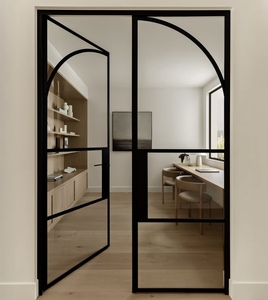
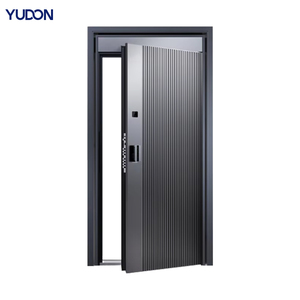
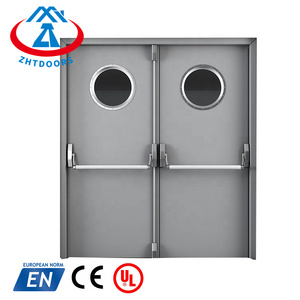
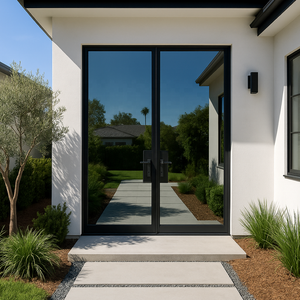
Executive Summary: Navigating China Wholesale Modern Aluminium Front Doors Procurement
In contemporary architectural design and luxury real estate development, the front entry door serves as a critical structural element that dictates building aesthetic, thermal envelope efficiency, perimeter security, and structural longevity. For global project developers, general contractors, architectural procurement managers, and wholesale importers, sourcing high-performance China wholesale modern aluminium front doors has transformed from a mere cost-optimization tactic into a high-value strategic decision.
Guangdong Province, specifically Foshan City, stands as the world's primary manufacturing cluster for precision aluminium extrusions and high-end entrance doors. Modern aluminium front doors manufactured by industry leaders such as Guangdong Derki Doors & Windows Technology Co., Ltd. leverage advanced 6063-T5/T6 alloy profiles, polyamide thermal barrier technology (PA66GF25), multi-point security locking hardware, and architectural-grade fluorocarbon (PVDF) surface treatments. This technical whitepaper explores the structural engineering, thermodynamic performance, material typologies, future procurement trends, and quality verification standards necessary to execute successful international supply chain operations.
Information Gain Insight for Sourcing Engineers
Unlike standard steel or composite doors, architectural aluminium alloy front doors offer an unmatched strength-to-weight ratio, zero structural warping in high-humidity zones, complete immunity to termite infestation, and infinite design customization—ranging from massive modern pivot systems to integrated thermal break dual-glass profiles.
1. Structural Engineering & Metallurgy of Aluminium Front Doors
To evaluate the quality of wholesale modern aluminium front doors, procurement officers must look beyond surface aesthetics and analyze the core metallurgical composition and structural profile geometries.
1.1 Aluminium Profile Metallurgy: 6063-T5 vs. 6061-T6
The structural backbone of high-end entrance doors relies on extruded aluminium alloys. The most widely specified grade for architectural fenestration and heavy-duty entrance doors is 6063-T5, recognized for its exceptional surface finish capabilities, corrosion resistance, and precise extrusion tolerance. For extreme structural demands—such as oversized luxury pivot doors exceeding 3.5 meters in height—engineers frequently utilize 6061-T6 alloy components to maximize tensile strength (reaching up to 290 MPa).
1.2 Polyamide Thermal Break Technology (PA66GF25)
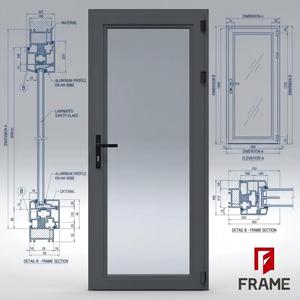
Raw aluminium profile extrusions possess high thermal conductivity ($K \approx 200 \text{ W/m}\cdot\text{K}$). Uninsulated single aluminium frames act as thermal bridges, causing heat gain in tropical climates and condensation/heat loss in cold environments. Modern wholesale front doors from premium Chinese exporters incorporate Polyamide PA66 reinforced with 25% fiberglass (PA66GF25) thermal barrier strips.
- Thermal Bridge Interruption: Reduces overall frame thermal transmittance ($U_f$) down to $1.3 - 1.8 \text{ W/m}^2\cdot\text{K}$.
- Structural Stability: PA66GF25 shares identical coefficient of thermal expansion ($\approx 2.3 \times 10^{-5}/\text{K}$) with aluminium alloy, preventing delamination under extreme ambient temperature shifts ($-40^\circ\text{C}$ to $+80^\circ\text{C}$).
Wall Thickness Specs
Structural wall thickness ranges from 2.0mm to 3.0mm for load-bearing frames, ensuring superior structural stability under heavy wind loads.
Anti-Burglary Class
Equipped with multi-point European groove locking systems, anti-pry hook locks, and hidden heavy-duty continuous or pivot hinges.
Weather Sealing
Triple-layer continuous EPDM gasket sealing combined with internal pressure-equalized drainage channels blocks water penetration.
2. Architectural Sourcing Matrix: Material & Typology Breakdown
When executing bulk purchasing orders for residential real estate developments, commercial hotels, or industrial corporate headquarters, selecting the appropriate door material typology is vital. The table below outlines key engineering performance metrics evaluated by structural engineers and commercial buyers.
| Door Material Typology | Thermal U-Factor (W/m²K) | Acoustic Insulation (STC) | Corrosion Resistance | Structural Wind Rating | Target Application |
|---|---|---|---|---|---|
| Thermal Break Aluminium Alloy | 1.2 - 1.6 | 38 - 45 dB | Outstanding (PVDF / Powder) | AS2047 N6 (Cyclone Proof) | Modern Villas, High-End Homes |
| Cast Aluminium Solid Door | 1.8 - 2.2 | 35 - 40 dB | Exceptional (Zero Rust) | Heavy Impact Resistant | Luxury Estates, Main Gates |
| Stainless Steel Entry Door | 2.2 - 2.8 | 32 - 38 dB | High (304/316 Grade) | High Force-Entry Deflection | High-Security & Coastal Sites |
| Double Glazed Aluminium French | 1.4 - 1.8 | 36 - 42 dB | Excellent | Medium-High | Courtyard, Showrooms, Lobbies |
| Steel Fire-Rated Door (90 Min) | 2.5 - 3.0 | 30 - 35 dB | Moderate (Requires Coating) | High Fire & Smoke Containment | Factories, Emergency Exits |
3. Global Sourcing & Procurement Trends for Aluminium Front Doors (2025–2030)
Understanding emerging technology trajectories allows global buyers, architectural firms, and distributors to make future-proof investment decisions. Sourcing modern aluminium front doors from China involves analyzing key global trends:
Trend 1: Oversized Modern Pivot Entrance Systems
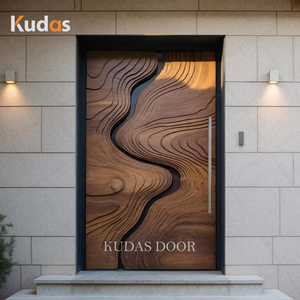
Architects worldwide are shifting away from traditional standard-sized single swing doors toward dramatic, large-format pivot doors. Capable of supporting leaf weights up to 500 kg and widths over 2.0 meters, modern aluminium pivot doors utilize heavy-duty hydraulic floor spring spindles, concealed top pivots, and perimeter magnetic weather seals. Aluminium's high strength-to-weight ratio makes it the premier material choice, as solid wood or steel of similar scale suffers from sag, hinge failure, and thermal warping.
Trend 2: Smart Access Control & IoT Hardware Integration
Wholesale procurement specifications now routinely request factory-integrated electronic locking mechanisms. Leading exporters pre-install 3D facial recognition cameras, biometric fingerprint scanners, encrypted RFID keycards, and smartphone-controlled Tuya or TTLock Bluetooth/Wi-Fi smart locks. Factory-level wire conduit routing inside the aluminium door leaf ensures clean, tamper-proof electrical installation.
Trend 3: Architectural Surface Durability: PVDF vs. Anodizing
For coastal real estate developments (e.g., Australia, Florida, Middle East, Southeast Asia), ocean salt spray destroys inferior paint finishes within 24 months. Procurement contracts increasingly specify Fluorocarbon (PVDF) 3-coat paint systems or 25-micron Architectural Anodizing. These coatings undergo 3,000+ hours of continuous neutral salt spray testing (ISO 9227) without blistering, chalking, or color fading.
Trend 4: Carbon Footprint Transparency & Recyclability
Aluminium is infinitely recyclable, retaining 95% of its structural properties during secondary smelting. Global buyers targeting LEED or BREEAM building certifications prefer Chinese suppliers who leverage low-carbon recycled aluminium billets powered by hydropower extrusions.
Enterprise Advantage: Guangdong Derki Doors & Windows Technology Co., Ltd.
When sourcing China wholesale modern aluminium front doors, supplier capabilities determine project execution success. Located in Shishan Town, Nanhai District, Foshan City—the heart of China's aluminum industrial base—DERKI represents the pinnacle of Chinese door manufacturing engineering.
180,000 m² Production Ecosystem
State-of-the-art facility staffed by over 600 skilled technicians, housing automated CNC profile machining centers, robotic corner welding, and dust-free powder coating lines.
25+ Years Industrial Mastery
Established in the late 1990s, DERKI has accumulated over two decades of technical research and structural innovation, holding more than 100 patents worldwide.
Global Testing Certifications
Products are certified to CE, ISO 9001, AS2047 (N6 cyclone rating), UL fire-rated standards, FCC, and RoHS, providing seamless compliance for international building codes.
Full CAD Engineering Support
Free in-house CAD shop drawing generation for custom project schedules, ensuring precise dimensional fit and effortless on-site installation by local contractors.
5. Step-by-Step Quality Assurance & Procurement Protocol
To ensure smooth international procurement from factory floor to job-site installation, international buyers should adhere to this standardized six-stage sourcing protocol:
Stage 1: RFQ & Schedule Review
Submit architectural elevations, door schedules, opening dimensions, required wind load ratings, and hardware preferences to the factory engineering team.
Stage 2: CAD Shop Drawings
Review factory-provided shop drawings detailing frame cross-sections, thermal break placement, wall anchorage points, drainage routing, and glass specifications.
Stage 3: Precision Fabrication
Precision CNC cutting of 6063-T5 aluminium profiles, structural corner crimping with two-component adhesive, and thermal strip insertion under ISO 9001 quality controls.
Stage 4: Factory Pre-Assembly
Every door leaf is trial-fitted into its outer frame in the factory to test lock alignment, hinge smoothness, gasket compression, and dimensional tolerances.
Stage 5: Lab Performance Testing
Random batch testing in air infiltration chambers (ASTM E283), water penetration test rigs (ASTM E331), and structural wind deflection racks (ASTM E330).
Stage 6: Export Crating & Freight
Protective scratch-resistant film application, corner bumper guards, and heavy-duty fully sealed plywood crates engineered for multi-modal ocean shipping.
6. Frequently Asked Questions (FAQ) for Sourcing Managers
Here are direct engineering answers to common technical queries raised by global importers, architects, and building material wholesalers.
Why choose aluminium alloy front doors over traditional wood or steel doors?
Aluminium alloy front doors offer significant advantages in dimensional stability, weather resistance, and strength-to-weight ratio. Unlike wooden doors, aluminium will not swell, crack, rot, or warp when exposed to extreme moisture or thermal fluctuations. Compared to standard steel doors, aluminium provides superior corrosion resistance (especially when finished with PVDF powder coating or anodizing) and allows for much larger custom sizes, slim sightlines, and complex thermal break profiles without rust risk.
What certifications are required to import aluminium front doors into North America, Europe, and Australia?
Certifications depend on regional building codes:
• Australia & New Zealand: AS2047 standard (covering air infiltration, water penetration, and ultimate strength up to N6 cyclone rating) and AS1288 glass compliance.
• Europe: CE Marking compliance under EN 14351-1, ISO 9001 quality system management, and RoHS verification.
• North America: NFRC thermal ratings, AAMA window/door performance standards, and UL 10C fire-rated compliance for commercial entry doors.
How do thermal break aluminium front doors prevent energy loss in extreme climates?
Thermal break aluminium doors utilize a non-conductive polyamide strip (such as PA66GF25) inserted between the interior and exterior aluminium profile extrusions. This structural insulation barrier stops thermal bridging, preventing cold or heat from conducting through the metal frame. Combined with low-emissivity (Low-E) double or triple glazed insulated glass units filled with argon gas, the door system can achieve U-factors as low as 1.2 W/m²K, substantially lowering HVAC heating and cooling costs.
Can Chinese entry door exporters customize dimensions, finishes, and locking hardware?
Yes. Manufacturers like Guangdong Derki Doors & Windows offer 100% bespoke production. Doors are manufactured directly according to architect-submitted CAD drawings. Customization includes frame dimensions, glass specifications (frosted, tinted, laminated, bulletproof), surface finishes (any RAL powder coating, PVDF, anodized, architectural wood-grain heat transfer), and hardware integration (European multi-point mortise locks, electronic biometrics, hidden floor pivot springs).
What surface finish is best suited for coastal or high-salinity marine environments?
For coastal locations, a 3-coat PVDF (Fluorocarbon) resin coating or an Anodized finish with a thickness of 25 microns or greater is strongly recommended. PVDF coatings contain Kynar 500 / Hylar 5000 fluoropolymer resins that resist UV degradation, salt spray oxidation, chemical airborne pollution, and color chalking, maintaining integrity for 20+ years under harsh coastal exposure.
How are heavy aluminium front doors packed to prevent freight damage during container shipping?
Export packaging involves a rigorous multi-layer protection system:
1. Electrostatic protective film covers all finished metal surfaces.
2. High-density EVA foam corner protectors shield frame edges.
3. Entire door assemblies are wrapped in waterproof bubble wrap.
4. The door is packed inside a fumigation-free, heavy-duty plywood crate reinforced with steel banding, preventing drop impact, vibration, and moisture exposure during transit.
Partner with China's Premier Aluminium Front Door Manufacturer
Accelerate your project schedule with factory-direct pricing, certified engineering compliance, and custom CAD drawing support from Guangdong Derki Doors & Windows Technology Co., Ltd.