Featured Thermal Break & Architectural Entry Doors
Explore our certified product lineup engineered for residential luxury villas, high-rise developments, and commercial entrance gates worldwide.
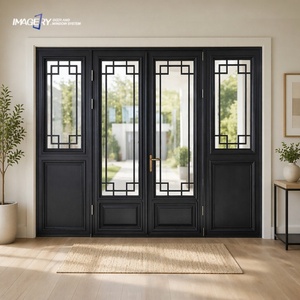
Best Aluminum Double Casement Genuine Antique Glass Doors With Built-in Glass Grilles Design For Sale Manufacturer
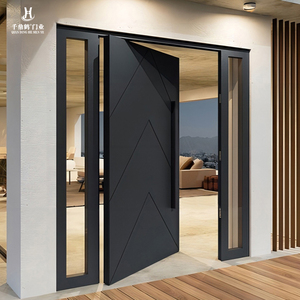
Modern Residential Cast Aluminum Glass Pivot Doors, Custom-made Unequal Double Doors at the Entrance of High-end Residences
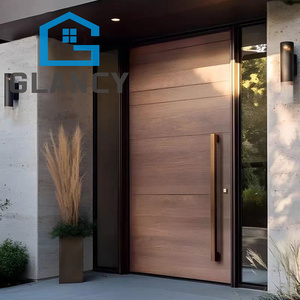
Modern Pivot Large 3 Point Lock Smart Steel Chines Anti-Theft Villa Wood Entry Hotel High Quality Water Resistant Security Door
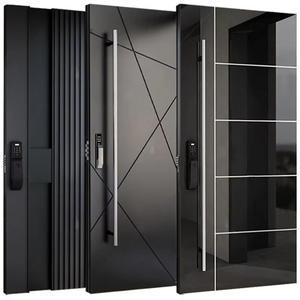
Alucasa Modern Design New Style Entrance Pivot Front Aluminum Door Luxury Villa Modern Glass Door for Houses
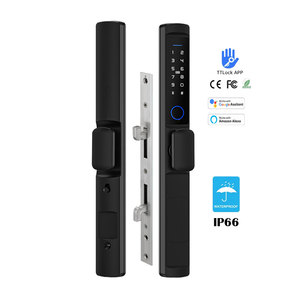
Smart Door Lock Waterproof Stainless Steel Sliding Gate Digital Aluminum Fingerprint Door Lock F2
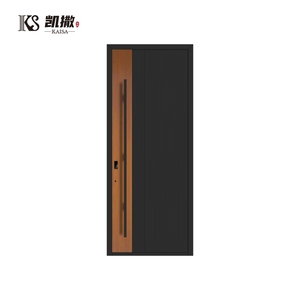
Metal Cast Aluminum Pivot Entrance Door Modern Stainless Steel Front Entry Security Doors for House Exterior
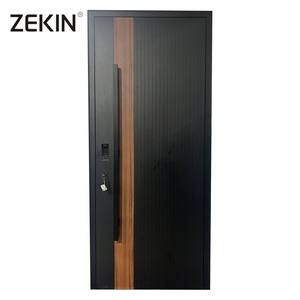
ZEKIN New Design Luxury Entry Aluminum Metal Entrance Door For Houses Villa Main Doors Custom Front Exterior Pivot Door
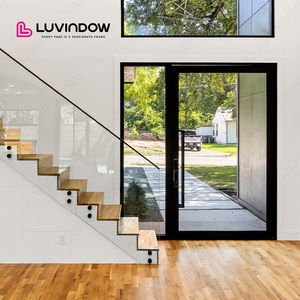
Modern Style Main Entrance Door Heat Insulated Aluminum Double Glazed Glass Pivot Door
Engineering Principles of Thermal Break Aluminum Door Systems
In modern architectural engineering, entry doors serve as both critical thermal boundaries and structural statements. Standard aluminum profiles, while valued for their high strength-to-weight ratio and corrosion resistance, possess an inherent physical limitation: high thermal conductivity ($K \approx 200 \text{ W/m}\cdot\text{K}$). Uninsulated aluminum acts as a massive thermal bridge, allowing rapid conductive heat loss during cold winters and thermal radiation gain during hot summers. This dynamic inevitably causes internal surface condensation, energy efficiency degradation, and elevated HVAC operational costs.
To overcome this limitation, top trusted thermal break aluminum door manufacturers utilize advanced multi-chamber extrusion profiles joined by low-conductivity continuous thermal barrier struts. The industry gold standard utilizes PA66GF25 (Polyamide 66 reinforced with 25% glass fiber). This material matches the thermal expansion coefficient of structural aluminum alloy (6063-T5/T6) while delivering a thermal conductivity of merely $0.3 \text{ W/m}\cdot\text{K}$—nearly 600 times lower than raw aluminum. By mechanically crimping PA66GF25 thermal struts between inner and outer aluminum extrusions, the conductive pathway is broken, achieving optimal U-values ($U_f \le 1.2 \text{ W/m}^2\text{K}$) and high Condensation Resistance Factors (CRF > 75).
| Performance Index | Standard Non-Thermal Aluminum | PA66GF25 Thermal Break Aluminum | Structural Timber / Solid Wood | Steel Composite Armor Door |
|---|---|---|---|---|
| Thermal Transmittance ($U_w$) | $3.5 - 5.8 \text{ W/m}^2\text{K}$ | $0.8 - 1.6 \text{ W/m}^2\text{K}$ | $1.4 - 2.2 \text{ W/m}^2\text{K}$ | $1.8 - 3.0 \text{ W/m}^2\text{K}$ |
| Structural Integrity & Wind Load | Very High (2.5 - 4.0 kPa) | Extreme (AS2047 N6 $\ge 6.0 \text{ kPa}$) | Moderate (Prone to warping) | Extreme (Heavy structural frame) |
| Sound Insulation (STC / $R_w$) | 22 - 28 dB | 38 - 48 dB (Acoustic Double IGU) | 30 - 35 dB | 32 - 40 dB |
| Weathering & Coastal Resistance | High (Anodized/Powder) | Superior (Fluorocarbon PVDF / C5-M) | Poor (Splits, rots under moisture) | Moderate (Rust risks on seams) |
| Maintenance Lifecycle | 30+ Years | 50+ Years Zero-Maintenance | 5-7 Years (Requires sealing) | 15-20 Years |
Why Guangdong Derki Doors & Windows Technology Co., Ltd. Leads the Global Industry
Rooted in Foshan—China's world-renowned aluminum profile and architectural hardware manufacturing capital—DERKI delivers enterprise-grade OEM/ODM solutions backed by rigorous global certifications.
180,000㎡ Smart Factory Base
Our state-of-the-art facility features fully automated German CNC extrusion lines, high-precision laser welding stations, and automated electrostatic PVDF fluorocarbon powder coating channels for zero-defect output.
Multi-National Certified Compliance
DERKI entry doors undergo rigorous independent lab testing, certified to CE, ISO 9001, AS2047 (N6 wind pressure level), UL Fire-Rated, FCC, and RoHS standard specifications for global regulatory approvals.
Free CAD & BIM Engineering Support
Every commercial or luxury residential project receives free dedicated technical submittals, including custom shop drawings, BIM models, structural load calculations, and hardware integration schemes.
Future B2B Procurement Trends in Thermal Break Door Systems
As global building codes tighten around decarbonization and energy efficiency, door procurement criteria are shifting dramatically. Key macro trends shape global developer purchasing strategies:
1. Passive House & Zero-Carbon Standard Adoption
Governments across North America, Europe, and Australia are enforcing ultra-low $U$-value requirements. Future door procurement will demand triple-glazed Low-E insulated glass units (IGU) filled with 90%+ Argon gas, integrated with aerogel-filled thermal cavities to achieve door system values below $0.8 \text{ W/m}^2\text{K}$.
2. Concealed Smart IoT & Biometric Integration
High-end residential and commercial buyers no longer accept retrofitted smart locks. Modern procurement specs dictate factory-integrated, concealed motorized multi-point locking systems compatible with smart home protocols (Matter, Zigbee), facial recognition, and biometric sensors built into structural door handles.
3. Oversized Architectural Pivot Form Factors
Grand entrances are replacing traditional narrow double doors. The demand for massive pivot doors (widths up to 2.5m, heights exceeding 4.0m) requires high-strength 6063-T6 aluminum extrusions paired with hydraulic bottom pivot hinges engineered to support single sash weights up to 500 kg smoothly.
Technological Evolution of Thermal Break Door Manufacturing
The thermal break door industry has transitioned through three major technological generations over the past 30 years:
-
Generation I (1990s - 2000s): Pour-and-Debridge Polyurethane Foam Systems
Early thermal break designs relied on liquid polyurethane poured into extrusions and subsequently cut away. While offering basic thermal insulation, these systems suffered from mechanical weakness, shear failure under structural wind loads, and thermal expansion mismatched with aluminum profiles. -
Generation II (2010s): Crimped Polyamide PA66GF25 Flat Strips
The industry standardized on high-strength PA66GF25 mechanical crimping. Flat thermal strips isolated inner and outer frames, dramatically boosting structural shear strength and improving frame U-values ($U_f \approx 2.0 - 2.5 \text{ W/m}^2\text{K}$). -
Generation III (Current Era): Multi-Chambered Aerogel Co-Extrusion Systems
Today's cutting-edge manufacturers like DERKI employ multi-cavity PA66GF25 thermal struts combined with low-emissivity insulation sponges, aerogel cavity infill, and multi-stage EPDM continuous gaskets. This reduces frame thermal transmittance to $U_f < 1.0 \text{ W/m}^2\text{K}$ while maintaining extreme structural wind load capability.
Frequently Asked Questions by Enterprise B2B Buyers
Key technical and commercial queries addressed by our senior door engineering team.
1. What aluminum alloy grade and surface treatment are used for coastal projects?
For coastal or high-salinity environments (C4/C5 corrosion categories), we utilize prime-grade 6063-T5 / 6063-T6 structural aluminum extrusion profiles. For surface finishing, we apply Qualicoat Class 2 standard powder coatings or Kynar 500 fluorocarbon (PVDF) 3-coat paint finishes with a minimum dry film thickness of 40 microns. This configuration passes 3,000-hour neutral salt spray (NSS) testing, protecting the entry door from pitting, oxidation, and color fading.
2. How do your thermal break aluminum doors achieve AS2047 N6 structural certification?
AS2047 N6 represents Australia's highest standard for wind pressure, air infiltration, and water resistance (suited for cyclonic regions). Our structural engineers optimize profile wall thickness (up to 3.0mm structural wall on load-bearing frames), reinforced corner crimping joints with German two-component corner glue, and continuous multi-point stainless steel locking bars. This allows our doors to withstand ultimate wind pressure tests up to $\ge 6.0 \text{ kPa}$.
3. What is the turn-around lead time for custom CAD drawings and manufacturing?
Upon receiving your door schedule or architectural elevations, our engineering team returns comprehensive CAD shop drawings within 24 to 48 hours. Once shop drawings and color samples receive sign-off, standard production lead time at our Foshan base takes 25 to 35 business days depending on order volume and hardware complexity.
4. How are large pivot doors and cast aluminum entry doors protected during sea freight container transit?
Every single unit undergoes a 5-layer protective packing protocol: (1) Surface protective film on all alloy profiles, (2) High-density EPDM foam corner guards, (3) Bubble pack wrapping, (4) Moisture-proof vacuum sealing, and (5) Fully enclosed fumigation-free wooden crate enclosures reinforced with steel strapping. This guarantees zero scratching or structural misalignment during ocean transport.
5. Can DERKI supply UL-certified fire-rated aluminum and stainless steel entry doors?
Yes. DERKI manufactures specialized fire-rated door assemblies tested in accordance with UL 10B, UL 10C, and NFPA 252 standards. Our fire-rated pivot and entry doors carry 60-minute, 90-minute, and 120-minute fire resistance ratings, utilizing specialized ceramic insulating core materials and intumescent perimeter seals that expand under extreme heat to block smoke and flames.
6. What warranty coverage does Guangdong Derki Doors & Windows Technology Co., Ltd. provide?
We back our manufacturing quality with a comprehensive enterprise warranty: 10 Years on aluminum profile structural integrity and PA66GF25 thermal break assemblies, 10 Years on surface PVDF/powder coating integrity against chalking or peeling, and 5 Years on mechanical hardware and smart locking systems.
Partner with a World-Class Thermal Break Aluminum Door Manufacturer
Whether you are an architect, real estate developer, general contractor, or building material importer, Guangdong Derki Doors & Windows Technology Co., Ltd. provides factory-direct pricing, engineering expertise, and certified project delivery.