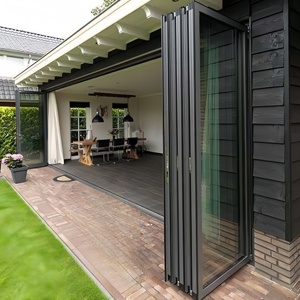
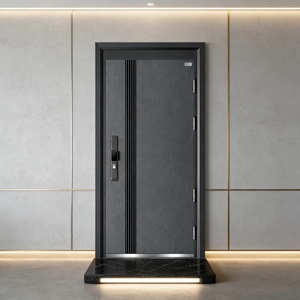
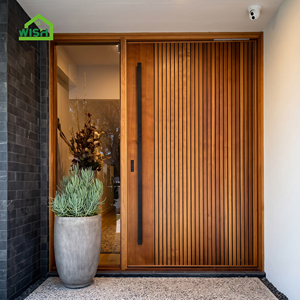
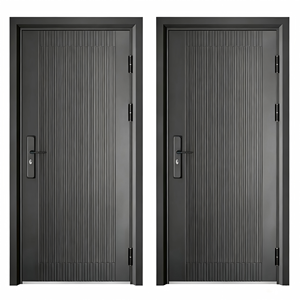
Soundproof Entry Door Engineering for the Austrian Architectural Market
Austria's building culture represents a sophisticated synthesis of historic preservation, rigorous structural physics, and strict municipal noise mitigation codes. From dense urban enclaves in Vienna's 1st and 7th Districts to high-altitude Alpine residences in Kitzbühel and Innsbruck, entrance doors must serve as multi-functional environmental barriers. As a premier international manufacturer and B2B exporter, Guangdong Derki Doors & Windows Technology Co., Ltd. delivers custom soundproof entry door systems engineered specifically to satisfy the exacting requirements of Austrian civil engineers, general contractors, developers, and door importers.
Information Gain & Technical Insight: Standard residential doors typically achieve a Weighted Sound Reduction Index ($R_w$) of 28 dB to 32 dB. DERKI's specialized acoustic entry doors combine high-density rockwool cores, viscoelastic constrained-layer damping membranes, continuous magnetic EPDM triple-gaskets, and automatic drop-down bottom seals to achieve certified acoustic isolation ratings up to $R_w = 48\text{ dB}$ ($C; C_{tr} = -2; -5\text{ dB}$ per EN ISO 10140-2).
Understanding Acoustic Physics: Decibel Reduction & Spectrum Adaptation
In noise pollution control, human acoustic perception is logarithmic. A 10 dB reduction in sound transmission is perceived by the human ear as a 50% decrease in loudness. Austrian urban centers—impacted by tram lines (Straßenbahn), heavy commercial transport, and high-density pedestrian corridors—exhibit low-to-mid frequency ambient noise patterns (100 Hz to 500 Hz). Achieving true interior tranquility requires specialized multi-layer acoustic dampening engineered to block both airborne sounds and structural vibrations.
Viscoelastic Damping Cores
Alternating layers of high-density aluminum alloy or stainless steel sheets bonded with polymer acoustic damping films prevent resonance flutters across low-frequency urban sound spectrums.
Polyamide PA66 Thermal Breaks
Engineered multi-chamber polyamide thermal barriers ($PA66GF25$) isolate interior and exterior aluminum profiles, eliminating thermal bridging and condensation in cold Austrian winters.
Automatic Drop Seals & Gaskets
Heavy-duty, floor-engaging automatic drop seals deploy upon door closure to create an airtight, sound-sealed threshold without requiring awkward physical raised sills.
Acoustic & Thermal Specification Comparison Matrix
The following performance benchmark highlights the technical metrics of DERKI entry door systems compared to conventional European market standards, evaluated against EN standards and Austrian ÖNORM building regulations:
| Performance Standard | Standard Residential Door | DERKI Soundproof Series | Austrian Code Reference |
|---|---|---|---|
| Acoustic Isolation ($R_w$) | 28 - 32 dB | 42 - 48 dB | ÖNORM B 8115-2 (Acoustic Comfort) |
| Thermal Transmittance ($U_d$) | 1.8 - 2.2 W/m²K | 0.75 - 0.95 W/m²K | OEI / OEGBC Passivhaus Standard |
| Air Permeability | Class 2 (EN 12207) | Class 4 (EN 12207) | ÖNORM B 5320 Tightness |
| Water Tightness | Class 4A (EN 12208) | Class E1050 (EN 12208) | Alpine Weather Exposure Proof |
| Burglar Resistance | RC1 / RC2 (EN 1627) | RC3 / RC4 (EN 1627) | High-Security Multi-Point Lock |
Localized Application Scenarios in Austria
Building designs across Austria vary substantially by geographical region and urban zoning. DERKI tailors door configurations, glass layering, hardware integrations, and surface treatments to harmonize with distinct local microclimates and structural applications.
Vienna & Linz Metro Apartments
Designed for urban renovations and luxury multi-family complexes facing high sound pressure levels from inner-city traffic and public transit. DERKI doors feature flush minimalist steel and aluminum finishes with hidden heavy-duty pivot hinges, delivering an soundproof buffer ($R_w \ge 45\text{ dB}$) while complementing contemporary interior design.
Tyrol, Vorarlberg & Salzburg Chalets
Exposed to severe snow loads, freeze-thaw cycles, and sub-zero temperatures down to -25°C. DERKI cast aluminum and thick-walled aluminum alloy doors incorporate extra-wide 34mm polyamide thermal breaks and triple-paned acoustic toughened glass with Low-E gas fill, preventing condensation frost and heat loss.
Graz Old Town & Klagenfurt Estates
Preserving architectural aesthetic character while integrating modern acoustic and thermal performance. Our factory produces custom embossed cast aluminum and decorative steel overlay doors that mirror classical European panel molding while housing modern multi-point automated locking mechanisms within.
Boutique Alpine Hotels & Commercial HQs
High-traffic hotel lobbies and corporate headquarters require effortless operation, motorized smart access (compatibility with Somfy, Winkhaus, and ekey fingerprint systems), and long-term mechanical durability tested to 500,000 open/close cycles.
Key Architectural & Industry Trends in the Austrian Market (2025–2030)
Driven by strict European Green Deal initiatives and evolving homeowner expectations, the Austrian entry door market is experiencing major technological shifts:
- Harmonization of Sound Isolation with Passivhaus Thermal Goals: Historically, heavy soundproofing materials compromised thermal isolation. Advanced composite cores using vacuum-insulation panels (VIP) integrated alongside acoustic rubberized sheets now achieve dual compliance ($U_d \le 0.75\text{ W/m²K}$ and $R_w \ge 45\text{ dB}$).
- Transition to Large-Format Pivot Door Architecture: Contemporary Austrian luxury residential design favors grand floor-to-ceiling entrances up to 3.5 meters in height. DERKI’s custom pivot hardware supports panel weights up to 500 kg while maintaining fingertip glide and perimeter compression sealing.
- Smart Keyless Access Integration: Integration of biometric readers, keypad entry, and smart-home automation embedded directly within the door’s thermal break frame is rapidly becoming standard across Austrian high-end construction schedules.
Technical Procurement FAQ for Austrian Buyers
Below are key technical answers addressing the most common questions raised by Austrian architects, project developers, and door distributors during procurement planning:
Do DERKI soundproof entry doors comply with Austrian ÖNORM standards?
Yes. DERKI entry door series are tested according to European Norms (EN ISO 10140-2 for acoustics, EN 12207 for air permeability, and EN 1627 for RC3/RC4 security). These EN test reports fully satisfy Austrian ÖNORM B 8115 (acoustic protection in building construction) and ÖNORM B 5320 (installation and sealing of windows and doors).
What is the exact lead time for custom door orders exported to Austria?
Standard fabrication time in our Foshan production facility is 25 to 30 business days following final CAD shop drawing approval. Ocean freight to European ports (such as Hamburg, Koper, or Rotterdam) followed by rail delivery to Austrian logistics hubs (Vienna, Linz, Graz) takes approximately 28 to 35 days.
How do your doors resist extreme Alpine temperature differentials without warping?
Extreme thermal differentials (e.g., +22°C interior vs -20°C exterior) cause conventional metal doors to warp due to asymmetrical expansion ("bimetallic effect"). DERKI utilizes patented multi-chamber split profiles connected with flexible shear-stiff polyamide PA66 insulators and anti-bi-metal alignment bars that allow independent expansion, maintaining perfect seal alignment year-round.
Can DERKI supply customized CAD shop drawings for local building submittals?
Absolutely. Our in-house engineering team provides detailed 2D CAD shop drawings and 3D BIM models free of charge prior to manufacturing. Drawings include exact structural anchor points, wall connection details per ÖNORM B 5320, thermal frame breaks, and hardware schematics.
What glass configurations are used for soundproof glass entry doors?
We utilize asymmetric laminated double or triple glazing (e.g., 8mm toughened exterior + 16mm Argon gas gap + 6mm acoustic PVB laminated interior glass). Asymmetric glass thicknesses break coincidence frequency dips, preventing noise transmission while providing burglar resistance.
How are doors packaged to prevent damage during long-distance transit?
Every door unit undergoes rigorous export packaging: protective anti-scratch surface film, heavy-duty rubber corner guards, bubble wrap layering, and fully enclosed IPPC-certified fumigated plywood crating with internal shock-absorbing foam spacers.
Enterprise Advantage: Why Partner with Guangdong Derki Doors & Windows Technology Co., Ltd.
Choosing an international door supplier requires complete confidence in engineering rigor, material quality, and delivery schedules. Guangdong Derki Doors & Windows Technology Co., Ltd. stands as an industry-leading manufacturer with over two decades of specialized expertise.
180,000 m² Manufacturing Scale
Our expansive industrial base houses automated German CNC machining centers, precision extrusion lines, automated powder coating bays, and rigorous quality inspection labs.
600+ Skilled Specialists
Backed by over 60 dedicated R&D engineers and bilingual technical project managers, we provide 24/7 technical communication matching European time zones.
Global Certification Portfolio
Fully certified under ISO 9001, CE marking, Australian AS2047 (N6 cyclone test), and UL fire-rating standards, guaranteeing swift customs clearance and local sign-off.
Whether you are sourcing custom front entry doors for a single luxury villa development in Kitzbühel or managing a major multi-family architectural tender in Vienna, DERKI delivers direct factory pricing, uncompromised structural integrity, and dedicated engineering consultation from initial design through final installation.